Session recap | Ignite 2026
Sales leaders often share that one or two top performers are carrying their team. But the teams that don't tend to have one thing in common: they run the basics the same way every time, from how they hire to how they review deals and meet with their reps.
Learning how to lead high-performing sales teams starts with that kind of consistency.
At Aspire's Ignite 2026, which brought together more than 1,500 professionals from landscaping, pest control, commercial cleaning, and other service industries, Dan Mandelbrot and Ben Walters led a roundtable on what it takes to build a high-performing sales team.
Dan, Group VP of Convex Sales at ServiceTitan, has spent about 20 years in sales, half of it leading teams. Ben leads one of Convex's sales teams and, years earlier, co-founded Niwot Landscaping in Colorado, where he ran sales and marketing.
The session covered three systems: hiring, deal evaluation, and team cadence, and many of the best ideas came from the sales leaders in the room.
Hire Against a Profile of Your Best Seller
Dan opened by asking attendees how they evaluate candidates today: a scorecard, gut instinct, or group consensus? Most said a combination, and when pressed, the honest answer was usually "gut."
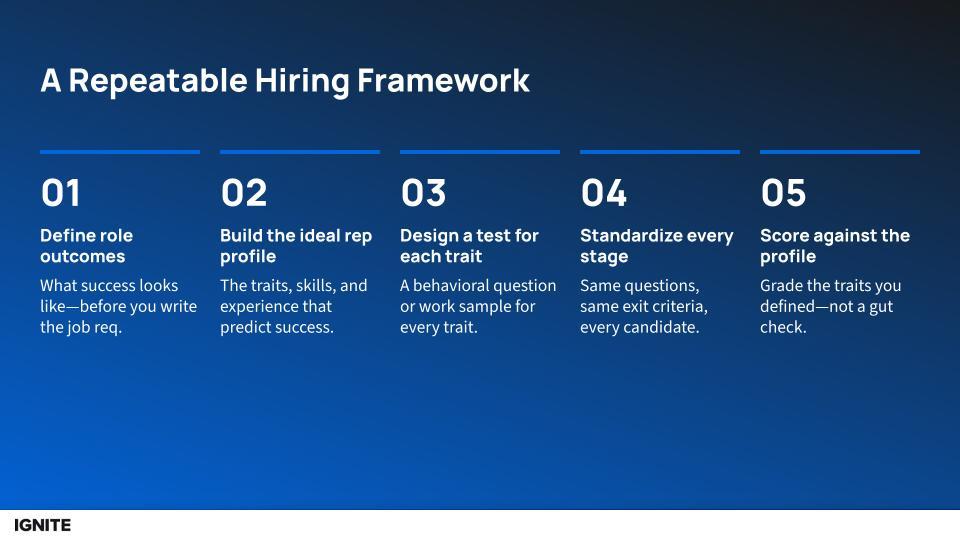
Dan's starting point is the reps already on your team. Before you interview anyone, write down what your best sellers have in common, the traits, skills, and experience that show up in the reps who ramp quickly and keep producing. That profile becomes a scorecard, and every candidate is graded against it.
"It's very hard to find someone if you don't compare them to something." - Dan Mandelbrot, Group VP, Convex Sales, ServiceTitan
Ben brought the idea of redesigning Convex's hiring framework to Dan for a simple reason: "The most important and impactful thing we do as sales leaders is hiring the right people, or the wrong people."
The standard he set was "unmistakable clarity" at decision time, a choice the whole team can see the reasoning behind.
A few habits make it work. Give each interviewer a different trait to score, ask every candidate the same questions, and let each leader take the questions closest to their own work.
Dan also suggested building your rubric into a tool like ChatGPT or Claude so it can compare candidates point by point, and recording interviews, with permission, takes your own biases out of the scoring.
When Dan asked the group what’s hardest about hiring, one answer came up first: finding people who are actually hungry. As one attendee put it, you can train almost anyone who’s hungry, humble, and smart. The hard part is telling in an interview whether the hunger is real.
Attendees shared a few signals that help:
A competitive background. One sales leader with 28 years in the industry has found that candidates who played sports tend to make strong salespeople, because they’re used to competing.
Time or money. Ask candidates which matters more to them. For a sales role, the answer should usually be money.
How they shop. Another team asks whether candidates believe that how you shop is how you sell. Someone who checks every price at the grocery store may struggle to sell value over cost - which is key in highly competitive markets.
Where to find candidates was a challenge as well. Some teams are promoting internally, moving customer service reps into entry-level sales roles so a departure doesn’t leave them starting from zero. Others rely on job boards, social media, and local job fairs.
The real debate was whether to hire from inside the industry at all. Several leaders in the room had stopped. One landscaping leader said candidates with no green-industry experience tend to do better, because they don’t bring old habits with them.
Dan had learned the same lesson from the other direction. He came to the trades from software, and early on he hired salespeople with backgrounds like his own. Then he realized he didn’t know the industry well enough to teach it to them. So his team flipped the profile, “because I could teach someone to sell all day.”
His advice is to start with your own strengths. If you’ve spent your career in the trades, you can teach the trade, so hire for sales skill. If you’re strongest at selling, hire people who already have industry experience.
Pick One Way to Judge Deals and Use It Every Time
When Dan asked how attendees know if a deal is real, the first answer got a laugh: "When it closes." That's an honest answer, but it doesn't help when an owner, a CEO, or a board needs a forecast.
"If you have no idea what's coming, that's a scary feeling." - Dan Mandelbrot, Group VP, Convex Sales, ServiceTitan
Convex's team uses the MEDDPICC sales methodology, but Dan was clear that the methodology matters less than using one consistently. It works in two layers: the checklist itself, and the discipline of asking about it in every one-on-one.
His example is the economic buyer. If a rep hasn't talked to the person who makes the decision, you know the deal is at risk.
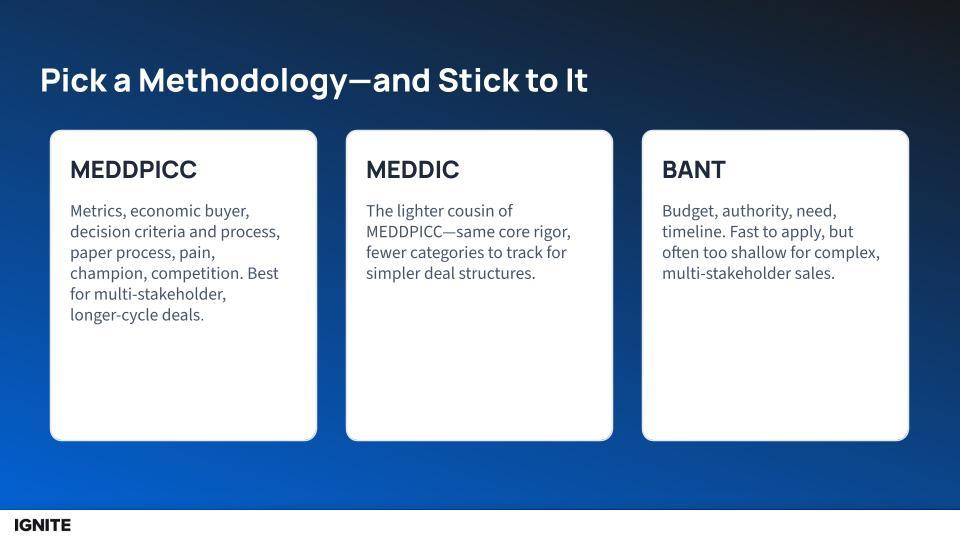
A methodology only works if you run every deal through it the same way. As the boxes get checked, each deal earns a confidence level, maybe 25%, maybe 50%, and that’s what you forecast against.
A deal moves forward once the buyer does something specific, like asking for a bid or coming back for a second round, so the rep’s gut can’t move it.
The hard part is the tracking. Dan’s team logs each deal’s methodology in Salesforce, and some call-recording tools can fill those fields in automatically. Without that, reps have to enter it themselves, “which we all know they don’t want to do,” Dan said.
Ben took the tracking off his reps’ plates. He built a project in Claude where a rep uploads a call recording and gets feedback measured against the team’s methodology: which boxes they checked, where they’re weak, and which questions would fill the gaps.
It also hands them what they need to update Salesforce, so logging the deal stops being a separate chore.
All of that assumes the deal is worth tracking.
Dan’s first filter comes before any methodology: does the buyer actually have a problem? “If you don’t have a problem, you’re not going to spend money,” he said.
A buyer who’s unhappy with their current vendor is far more likely to switch. A buyer who’s satisfied probably won’t, even if you come in at a lower price.
Coach One Metric at a Time
Ben's rule is to coach one metric at a time, per rep, and to coach the cause behind it rather than the number. A long sales cycle might trace back to a rep not getting next steps on the calendar, and that becomes the one thing the two of them work on.
"If you try to do multiple things at once, I think it's too much to juggle." - Ben Walters, Sales Leader, Convex
Run the Same Cadence Every Week
Cadence is where Dan named the theme of the whole session: "If you haven't picked up on it already, one of the themes of this presentation is just figure out consistency."
His team holds weekly one-on-ones with action items posted in Slack, so nobody has to remember last week's conversation.
Pipeline reviews happen first thing Monday, because "if you do it at the end of the week, people go out on the weekend, and all those things that you talked about get lost." A monthly business review checks the whole book against the number.
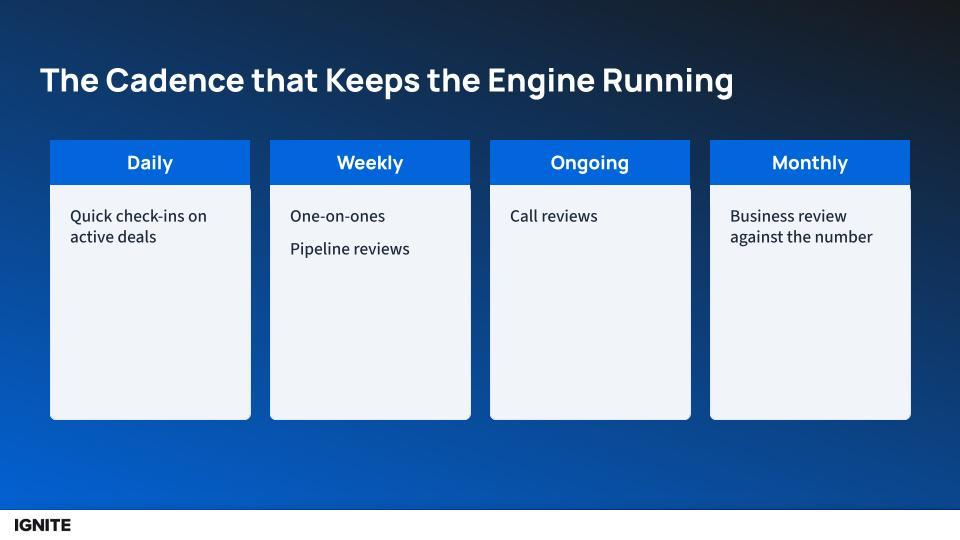
Dan also runs pipeline review as a team conversation. "I don't have all the answers. You don't have all the answers. The only way we're going to be successful is if we all work together."
Recognize the Middle of the Team
If recognition only rewards total revenue, the same two reps win it every month - so attendees shared ideas that work for their team.
One leader sends a banner to the whole team after every sale. Another opens a daily all-team meeting by reporting leads, appointments, bids, and sales, so everyone’s progress gets seen. A third takes the team on a quarterly outing where reps trade notes on what’s working.
One idea from the tables speaks to teams carried by one or two people. On a team of six with two high performers, a SPIFF tied to month-over-month improvement gives the other four something realistic to chase. As one attendee pointed out, sometimes those reps run right past everyone else for that recognition.
Recognition also covers the reps who are improving. Dan’s team has a plan for the ones who are struggling, and it starts from the hire. “We hired this person, we believe in them, and we want to give everything we can to make them successful,” Dan said.
A struggling rep gets a coaching plan before anyone talks about an exit, so they know the team still has their back through a bad stretch.
Sometimes the coaching plan shows the rep is in the wrong role. Several sales leaders in the room had moved a good person into account management instead of letting them go. As one attendee put it, it’s about finding “the right seat on the bus.”
The Biggest Takeaways from Dan Mandelbrot and Ben Walters at Ignite 2026
Profile your best seller before you hire. Score every candidate against the same written profile.
Pick one deal-qualification method. Use it on every deal, and ask about it in every one-on-one.
Know who the economic buyer is. If a rep hasn't met the decision maker, the deal isn't forecastable.
Coach one metric at a time. Find the cause behind the number and fix that first.
Run pipeline review on Monday. Next actions get done in the same week they're set.
Recognize improvement, not just bookings. Give the middle of your team something to chase.
If you'd like to see how Convex's sales team finds and works its pipeline, schedule a demo of Convex and we'll walk you through how it works.
Share