Session recap | Ignite 2026
Sales leaders can always tell how good last quarter was. Fewer can predict, with confidence, what next quarter will look like. A strong month usually traces back to a big referral or a property manager who called at the right time, and a slow month traces back to inbound inconsistency.
That gap closes once you've built a predictable sales pipeline - which comes from work your team controls: who you target, where new opportunities come from, what reps say when they reach out, and how you keep that effort steady week after week.
At Aspire's Ignite 2026 conference, Ben Walters, Sales Leader at Convex, walked a room of commercial services leaders through exactly that system. Ben has spent six years building Convex's sales team, and before that he co-founded a landscaping company in Colorado, where he ran sales and marketing himself.
At the opening of the session, he asked for a show of hands: how many people in the room had a clearly defined ideal customer profile?
Know Who You're Hunting
Ben defines a well-formed ICP as the characteristics your best-fit customers share: service delivery type, profitability, contract size and contract length, plus how easy they are to serve.
In his view, a “best-fit customer” is also one who pays their bills on time and refers you first.
Without an ICP, most sales teams treat every contact as an equal priority - and reps will burn hours on accounts that were never going to be worth the drive.
In landscaping, this could mean giving a small HOA on the other side of town the same outreach effort as a 40-acre commercial campus less than a mile away.
Ben's advice is to start with the customers you already have. Look at your most profitable accounts, the ones that pay on time and regularly send you referrals, and ask what they have in common.
Then add route density to the profile: a new job across town costs drive time, fuel and labor that a job two stops from an existing route doesn't.
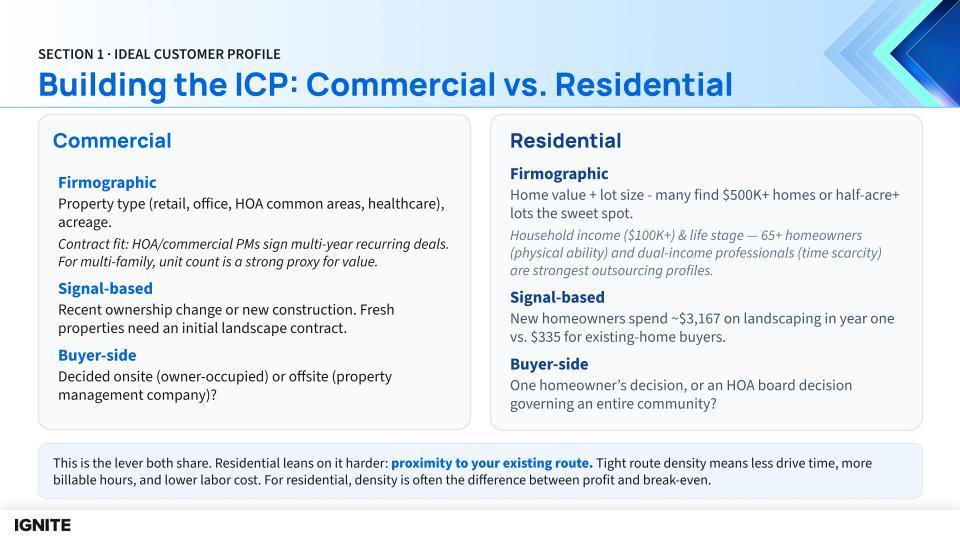
Does a narrow ICP shrink your market? Ben's answer is no. You'll still get leads through every channel you already have: inbound leads, referrals, and repeat business.
You take the best-fit slice of your total addressable market, roughly 10% of it by Ben's estimate, and focus your team's limited outbound selling hours there.
Build Pipeline on Purpose
Making a pipeline predictable, means building it on purpose. In Ben's session, that came down to three sources: proactive referrals, data that helps reps find and prioritize targets, and networking with a plan.
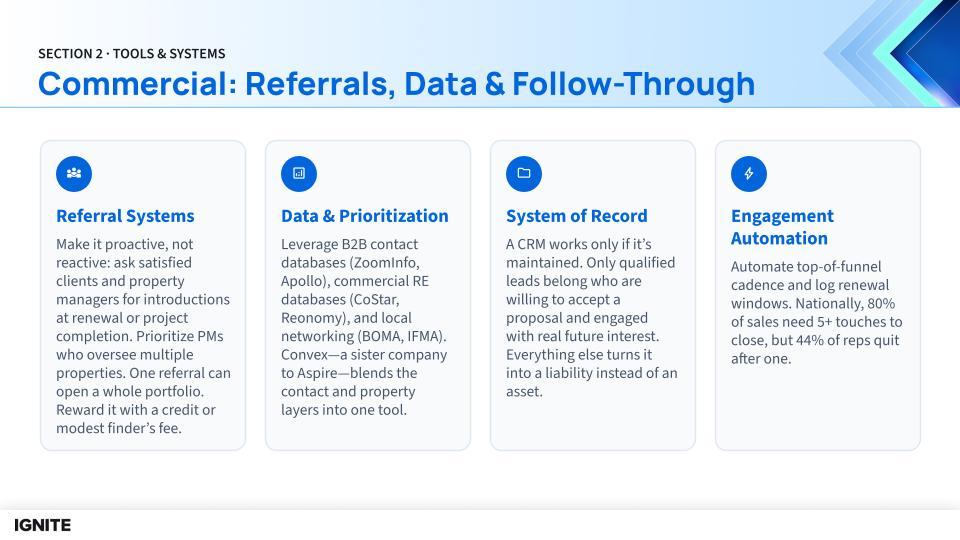
Ben's playbook is to ask for a referral at the point of highest satisfaction, think in portfolios, and make the thank-you personal. If one customer likes bourbon and another does Pilates, a small, specific gift goes a long way.
One attendee shared how their team turned this into a channel of its own. They host a Mother's Day spa day and a Father's Day "bourbon and blades" event for the property managers they work with. Word spread, and they now have a waitlist of property managers asking to be invited next year.
This is a perfect example of proactive referrals.
Most commercial services companies already get plenty of referrals the reactive way. Those leads are great, and they'll keep coming. But they arrive inconsistently, whether or not your sales team pursues them, so you can't build next quarter's pipeline on those leads alone.
Next, Ben talked about data - in other words getting your sales team the key insights they need to build relationships and close deals.
For sales insights and property data, a property intelligence tool like Convex offers the ability to outline a territory, filter the buildings inside the space by your ICP, and pull contacts for the people who manage them. That way the list of buildings and contacts already match your best customers and sit near the work you already do.
The third was networking with a plan.
Networking without a plan is fun, but doesn't produce much. If a rep goes to the monthly BOMA reception, has a few beers with friends and catches up, it's a pleasant evening.
The reps who get results have a strategy and do their homework first, looking up the property managers they want to meet on LinkedIn ahead of time so they can recognize them in a crowd.
Let the System Carry the Follow-Up
A lot of teams take every lead they find and drop it straight into the CRM. Ben's warning is direct: don't dump everything in on day one. A lead belongs in the CRM when it's qualified, meaning it fits the ICP and the contact has shown real future interest.
In Ben's experience, 80% of new sales pursuits happen after 5 touches - but most reps stop after one.
Every follow-up that lives only in a rep's memory is one that can be dropped. Once it's captured in a system the team trusts, the system does the remembering - not the rep.
Ben's fix is to automate as much of the cadence as you can. It might be an automated email or two, or a tool that lays out a sequence (say, eight steps over three weeks) and tracks each rep's progress through it.
Be Brief, Be Brilliant, and Be Gone
Most people your reps reach won't have a need that day or even that week. The goal of the call is to learn about timing. Say a property manager tells your rep they renew their landscape maintenance contracts every March. It goes into the CRM with an automated reminder set a couple of months before March, so the rep reengages ahead of the renewal instead of after it's been signed.
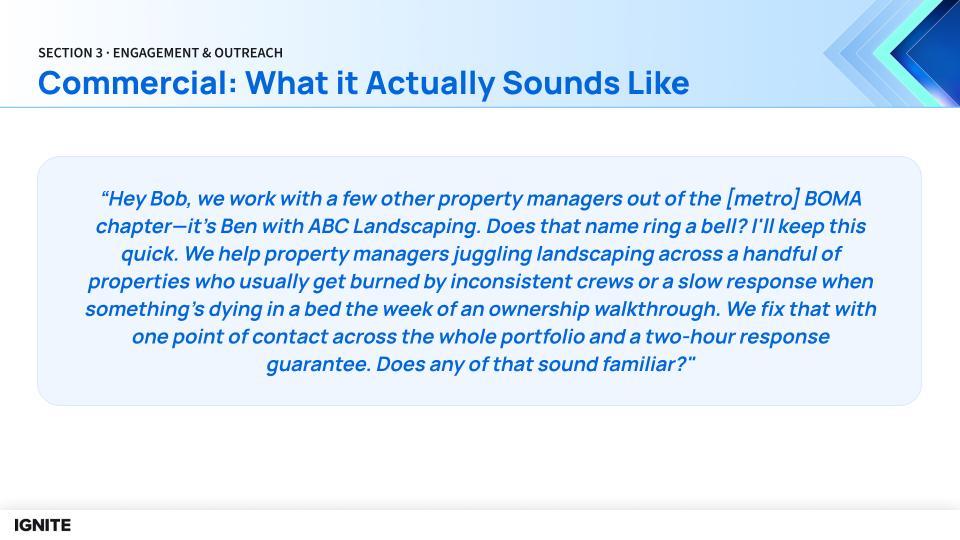
From there, lead with the prospect's problem. Ben hears the same mistake from sellers over and over: they open with how long the company has been in business and how good it is. "You interrupted their day," Ben said. "They don't want to hear you talk about yourself and your company. They care about their problems."
"Be brief, be brilliant, and be gone." - Ben Walters, Sales Leader, Convex
Ben's sample script ends on one intentional question: "Are you at a point where you're totally happy with your current landscaping provider?" A lot of people naturally gravitate toward telling you no, so asking whether they're totally happy gives them an easy opening to say they're not.
Residential Runs on a Different Playbook
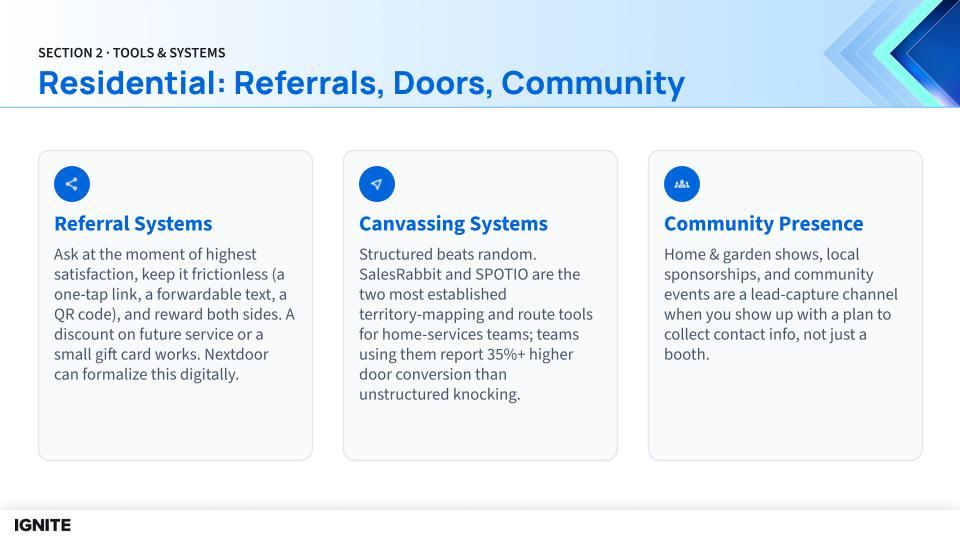
The goal is the same, but almost nothing about how you find residential customers carries over from commercial. Referrals and route density are the two exceptions, and both matter even more on the residential side.
On the commercial side, many teams build pipeline by buying a contact list and dialing. On the residential side, that approach runs straight into federal Do Not Call rules.
Ben laid out three channels that work instead: referrals that reward both sides, structured canvassing with a software system behind it, and community events with a plan to capture leads.
He also shared one of his own from his landscaping days. His customer base skewed older, so he found his way to the local bingo association and talked to its president. His company sponsored the event, one of his guys served as the bingo caller, and they set up a small booth out front. They were the only vendor there, and it became one of their most successful community events.
Coach the Inputs, Not Just the Number
Ben splits sales KPIs into two buckets: pipeline creation and pipeline execution. His advice is to tie the KPIs to the broader company goal, set them lower than you think you need at first, then build up. And please don't make your sellers log activity manually.
One attendee shared that their newest reps got discouraged when handed a large revenue number on day one, so they'd started giving reps activity KPIs for the first 90 days. Ben liked the approach a lot:
"You can control the inputs all day, every day. Activity, effort, preparation. You can't always control the output." - Ben Walters, Sales Leader, Convex
When the numbers fall short, Ben separates coaching into two types. Activity-based coaching is the easier one to spot: the rep isn't hitting their numbers. Non-activity-based coaching takes more digging: the rep is hitting their activity KPIs, but you're not seeing the results.
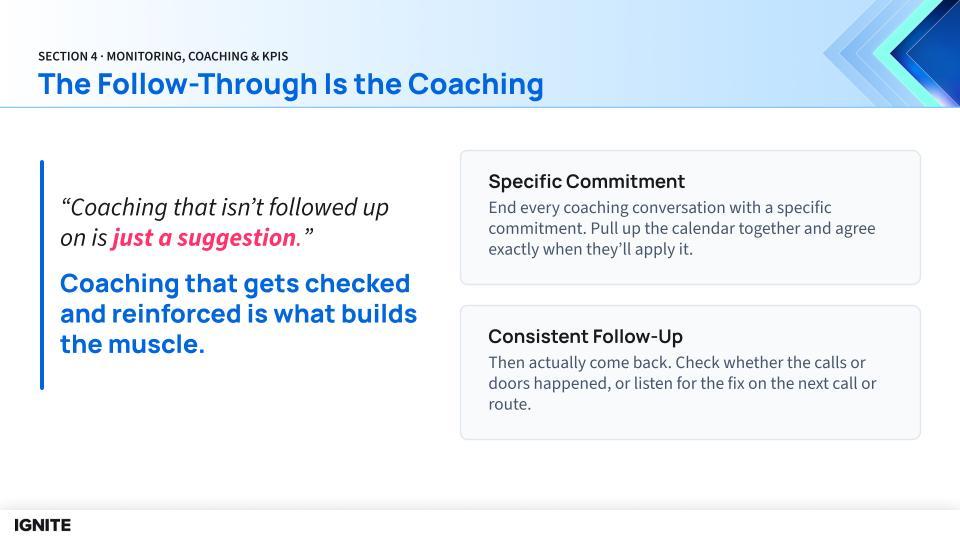
Once you find the gap, you role-play that moment a few times until the rep is comfortable with it.
Then put the follow-up on the calendar. If a rep's next prospecting block is Tuesday at 2 p.m., Ben drops a 15-minute check-in on the calendar for 3 p.m., right after that block.
Ben's experience is that after a few rounds of this, most reps get back on track toward quota.
The Biggest Takeaways from Ben Walters at Ignite 2026
Start with an ICP. Look at your most profitable accounts, the ones that pay on time and regularly send you referrals, and ask what they have in common.
Make referrals proactive. Ask at the point of highest satisfaction, usually contract renewal or project completion.
Keep the CRM clean. A lead belongs in the CRM when it fits the ICP and the contact has shown real future interest.
Lead with their problem. Be brief, be brilliant, and be gone.
Build residential pipeline without cold calls. Referrals, structured canvassing and community events carry the load.
Coach, then follow up. Find the specific cause of a gap, practice the fix and put the check-in on the calendar.
"Good salespeople can have bad days. You can never have bad weeks." - Ben Walters, Sales Leader, Convex
If you'd like to see how teams use property intelligence to find and prioritize buildings that fit their ICP so building a predictable sales pipeline is simple, schedule a demo of Convex - and we'll walk you through how it works.
Share